
The Bermuda Triangle
An insight into the "Devil's Triangle" and the mysteries surrounding it

While some of its popularity has faded away in recent years, the controversial nature of the Bermuda Triangle’s existence has managed to grip the interests of the masses for decades(especially in the United States). It has been featured in numerous movies and other media, including but not limited to Satan’s Triangle(1975), Airport ’77 (1977) and The Devil’s Triangle (1974). There’s even been a Scooby Doo film based on the area(A Creepy Tangle in the Bermuda Triangle(1978)) and a Wonder Woman movie too(The Bermuda Triangle Crisis(1977)). Needless to say, the Bermuda Triangle engrossed both children and adults alike. The idea of a haunted area from which traveller nor vessel could ever return was simple enough for younger audiences to enjoy yet had enough potential for extrapolation that adults would find it compelling as well. However, the transformation of this region into a pop culture icon was quite strange. I plan to cover all the details that we have about this special section of the world, and hopefully show you why so many people even found it interesting in the first place.
The Rundown
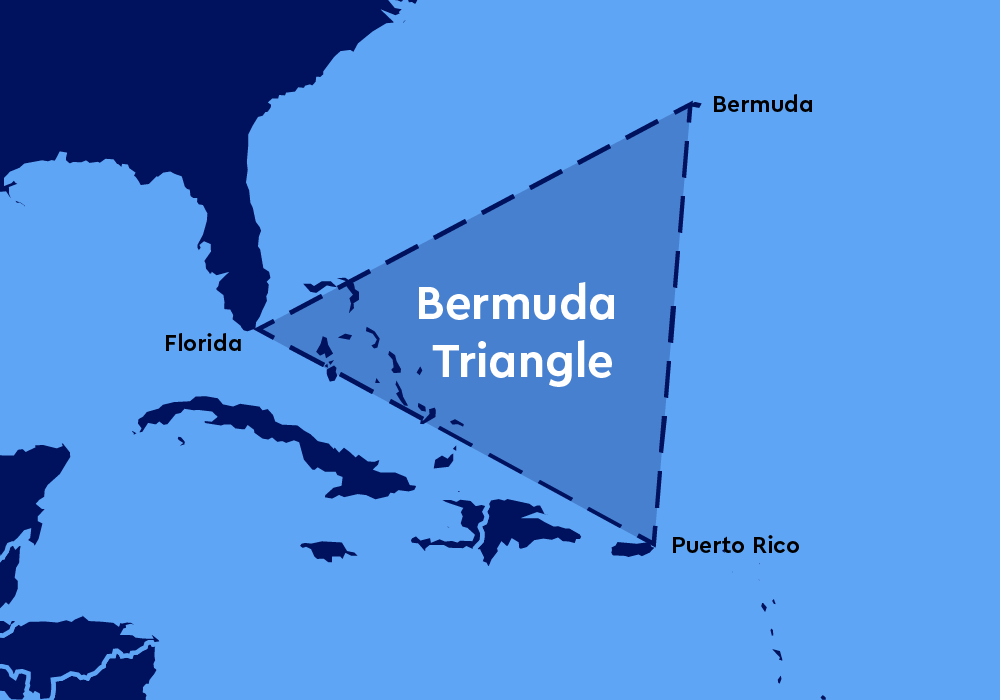
The Bermuda triangle is a region in the United States that is located in the western part of the North Atlantic Ocean. It is usually agreed upon that this triangle’s vertices can be found at Florida, Puerto Rico, and the British Overseas Territory of Bermuda itself. If you happened to be somewhere in the western parts of this triangle, you would probably stumble upon the Bahamas. It is a relatively big part of the ocean, being at least 1.3 million km2(or 0.5 square miles). If you noticed the lack of certainty in these details(“usually agreed upon”, “at least 1.3 million”, “probably stumble upon”), there is a good reason for this. A big part of the Bermuda triangle’s appeal is the lack of clear details about it, or the inconsistency of said details. There’s a reason indisputable information is so hard to find when researching this area, and that’s mainly because of the history behind it.
Ships and Planes, Lost to the Sea?
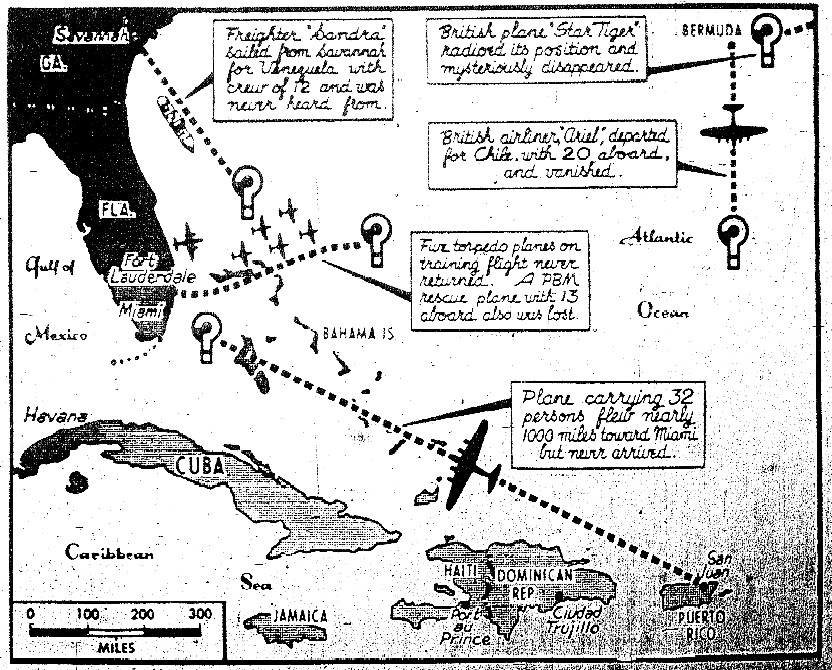
On September 1950, an article titled “Sea's Puzzles Still Baffle Men In Pushbutton Age” was published by the Miami Herald and distributed to the public by the Associated Press. This feature was the first one to recognize the unusual disappearances which happened in the area, although they never explicitly mentioned the triangle by its name. In fact, they didn’t mention a triangle at all. The main focus of the article seemed to be how, despite how globalisation seemed to make the entire world within their reach, there were still various strange occurrences that were happening all around them, seemingly with no real explanation. Here’s an excerpt of the text:
It's a small world? No, it's still the same vast globe the ancients knew, with the same misty limbo of the lost.
We think it is small because of speeding wheels and wings and the voice of radio which comes out of the void. A mile is only a minute's travel by wheel or a few seconds flight -- but it is still a mile.
The miles add up to a vast unknown into which a hundred and more persons have flown or sailed within brief memory, to be swallowed up just as ships were swallowed in the old sailing days.
The article continued to list down a few disappearances which had happened fairly recently(at the time):
The Sandra carried radio. It was a 350-foot freighter which sailed with 12 men on board from Miami to Savannah. There 300 tons of insecticide were loaded for Puerto Cabello, Venezuela. The Sandra sailed -- and disappeared without a trace.
On June 16, in the "small world" year of 1950, search was abandoned. The fate of the craft and the dozen on board was written down as an official mystery.
Where are the men and women and two babies -- 32 persons in all -- who happily boarded a plane at San Juan, Puerto Rico, and flew 1,000 miles toward Miami? A radio message at 4 a. m. Dec. 27, 1948, reported them 50 miles south of their goal. They never arrived.
Searchers scanned 310,000 miles of sea and land, but the elusive limbo into which they flew was on no map.
On Jan. 18, 1949, a great task force of the United States Navy was on maneuvers south of Bermuda. That same day a British airliner, the Ariel, vanished in the thin air through which it flew. The plane had left Bermuda with 20 persons on board on its way from London to Chile.
The naval force abandoned its maneuvers. Aircraft carriers, cruisers, destroyers combed the waters with thousands of pairs of sharp eyes on watch. They found no hint of the Ariel's fate.
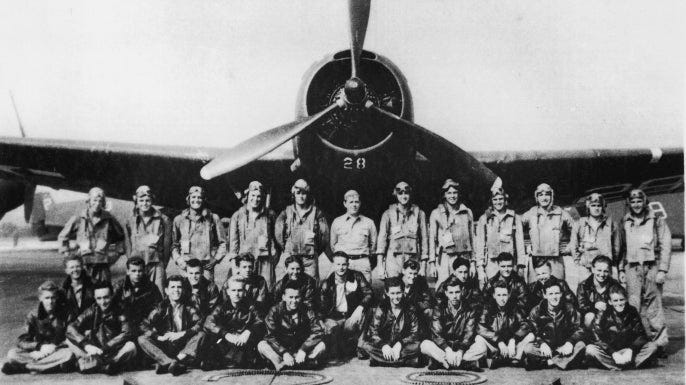
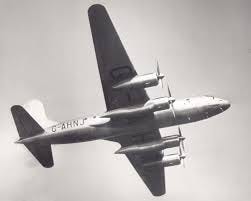
Along with these, they also made mention of the disappearance of the Star Tiger, a British plane with 29 people on board, which seemingly vanished as it was nearing Bermuda on 31st January, 1948. They also covered the disappearance of Flight 19, a training flight where five torpedo planes took wing from Navy's Fort Lauderdale air station 5th December, 1945. In both cases, the aircraft were never found.
(I would recommend reading this article for yourself if you’re really interested. It’s quite interesting, albeit a bit solemn. The link to the article is in the list of references I compiled below, but you can also find it here.)
Furthermore, there is a noteworthy aspect to the disappearance of Flight 19. At the beginning stages of the second leg of the practice flight, the flight leader, Charles Carroll Taylor, reported that they couldn’t be sure of where they were. Even more notably, one of the airmen reported this to the tower Personnel:
We can't find west. Everything is wrong. We can't be sure of any direction. Everything looks strange, even the ocean.
In hindsight, his words hinted at the possibility that the sea itself was paranormal, a possibility which would be further encouraged in the years to come.
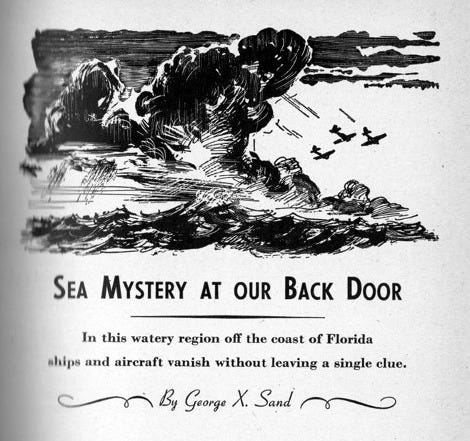
And come they did. Only two years later, on October 1952, Fate(a magazine centered around supernatural phenomena) published a more in-depth article about the triangular region, titled “Sea Mystery At Our Back Door”. It was written by George X. Sand, and in it, he recounted the disappearance of numerous vessels and planes since the end of World War 2. Most of these incidents were mentioned in the article by the Miami Herald, but there were also a few other cases, such as the disappearance of a fishing skiff holding three men on March 1948. Unlike the article by the Miami Herald, the article by Fate did take note of the correlation between the incidents and the approximate locations in which they happened. You can see this in the following extract of the article:
The region involved, a watery triangle bounded roughly by Florida, Bermuda and Puerto Rico, measures less than a thousand miles on any one side. A small area on any mariner’s map, it is hourly being ploughed by vessels of many nations. It is guarded over by radio. It is under constant surveillance from the dozens of commercial airliners that fly over it daily.
Yet its potential for mystery apparently remains just as great today as when Columbus sailed its murky green waters…
This was the first article to introduce the idea of a triangle in the first place. Even at this point, you could still see just how popular the Bermuda Triangle was.
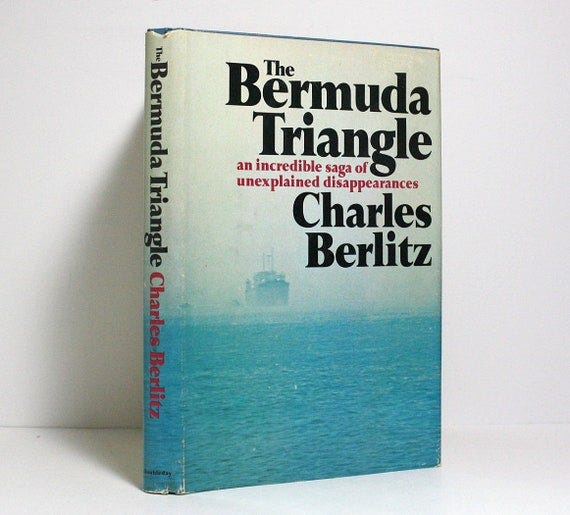
The fame(or rather, notoriety) of the triangle did not change in the coming years. In fact, it grew astronomically, with little to no significant opposition. In 1974, the book The Bermuda Triangle was written by Charles Berlitz, a polyglot and language teacher. Berlitz would elaborate on many of the theories surrounding the seemingly cursed part of the ocean, and he made use of numerous references to real life incidents to validate said theories. Surprisingly, this book went on to sell almost 20 million copies! Other writers such as Vincent Gaddis and Richard Winer would publish more articles and books about the Bermuda Triangle, often with more and more supernatural elements being included with each release.
This continued to be the case until 1975, when the truth of the long-standing mystery would be brought to light through a book aptly named The Bermuda Triangle Mystery: Solved. Written by Larry Kusche, a former research librarian and commercial pilot, the book took a critical stance regarding the supposedly supernatural area, claiming that the vast majority of the cases involving the Bermuda Triangle were either exaggerated to an unrealistic extent or were just plain lies.
Kusche’s work was especially critical of one of the first books to be written about the area, Invisible Horizons(written by Vincent Gaddis). He would present cases where the writers would intentionally leave out vital information(e.g. bad weather conditions) regarding the disappearances(a good example of this would be Flight 19, where the weather was reported to have worsened not too long after all communication was cut between the pilots and the tower personnel). His research would also expose the fact that certain writers would just fabricate details on the spot in order to keep up with the ‘supernatural’ theme. For example, two of US Air Force KC-135 Stratotanker aircraft crashed into each other within the Bermuda Triangle. Some writers claimed that, though the planes did collide, there were two separate crash sites with over 260 km(160 miles) of ocean in between them. In reality, there was only one crash site, and the “second” one was merely an old buoy entangled in seaweed and driftwood.
Overall, Kusche’s work concluded that the legend of the Bermuda Triangle was just a man-made mystery and that the writers were exploiting the sensationalism and appeal of the area(whether knowingly or otherwise).
His claims would be backed up by factual evidence which ultimately revealed that the Bermuda Triangle was not any more dangerous than any part of the ocean was. The number of disappearances reported in that area wasn’t significantly higher than it would be anywhere else(if anything, the Bermuda Triangle might have actually been safer than other places simple due to people being more careful when in that part of that Atlantic Ocean).
Eventually, Kusche’s sentiments were soon adopted by the masses. There are countless studies which only reinforce Kusche’s belief, and I doubt you would see anybody who is particularly weary of the Bermuda Triangle today.
I was initially surprised that so many people would consider the Bermuda Triangle to be seriously supernatural, but it does make sense. People tend to like mystery and drama(provided that they are not affected by it), and many paranormal reality TV shows continue to be watched by millions of people every day.
These are my sources:
-Gizmodo: The 10 Greatest Bermuda Triangle Moments in Pop Culture History
-Dictionary.com: Why Is It Called The Bermuda Triangle—And Is It Real?
-"Frequently Asked Questions: Bermuda Triangle Fact Sheet"
-Britannica: What Is Known (and Not Known) About the Bermuda Triangle
-National Oceanic And Atmospheric Administration: What is the Bermuda Triangle?
-Bermuda: The Legends And Lore Of The Bermuda Triangle
-Jones, E.V.W. (16 September 1950)."Same Big World: Sea's Puzzles Still Baffle Men In Pushbutton Age". Associated Press
-Physics 3333/CFB 3333: The Sandra Story
-The American Legion Magazine [Volume 72, No. 4 (April 1962)]
-Popular Mechanics: A Scientist Says He's Solved the Bermuda Triangle, Just Like That
And that’s it! It certainly has been a while since I’ve published an article. It’s fun making these, so I plan to publish an article at least once every month from now on. I’m also thinking of dividing more detailed topics into separate parts and make a series. At any rate, I’ll be writing something, so keep an eye out for my next article!